
EHG diplomas and certificates combine Swiss rigor with international recognition. They validate a demanding career path, supported by benchmark accreditations.

Accreditations and recognitions
Accreditations and recognitions
Simply Swiss excellence
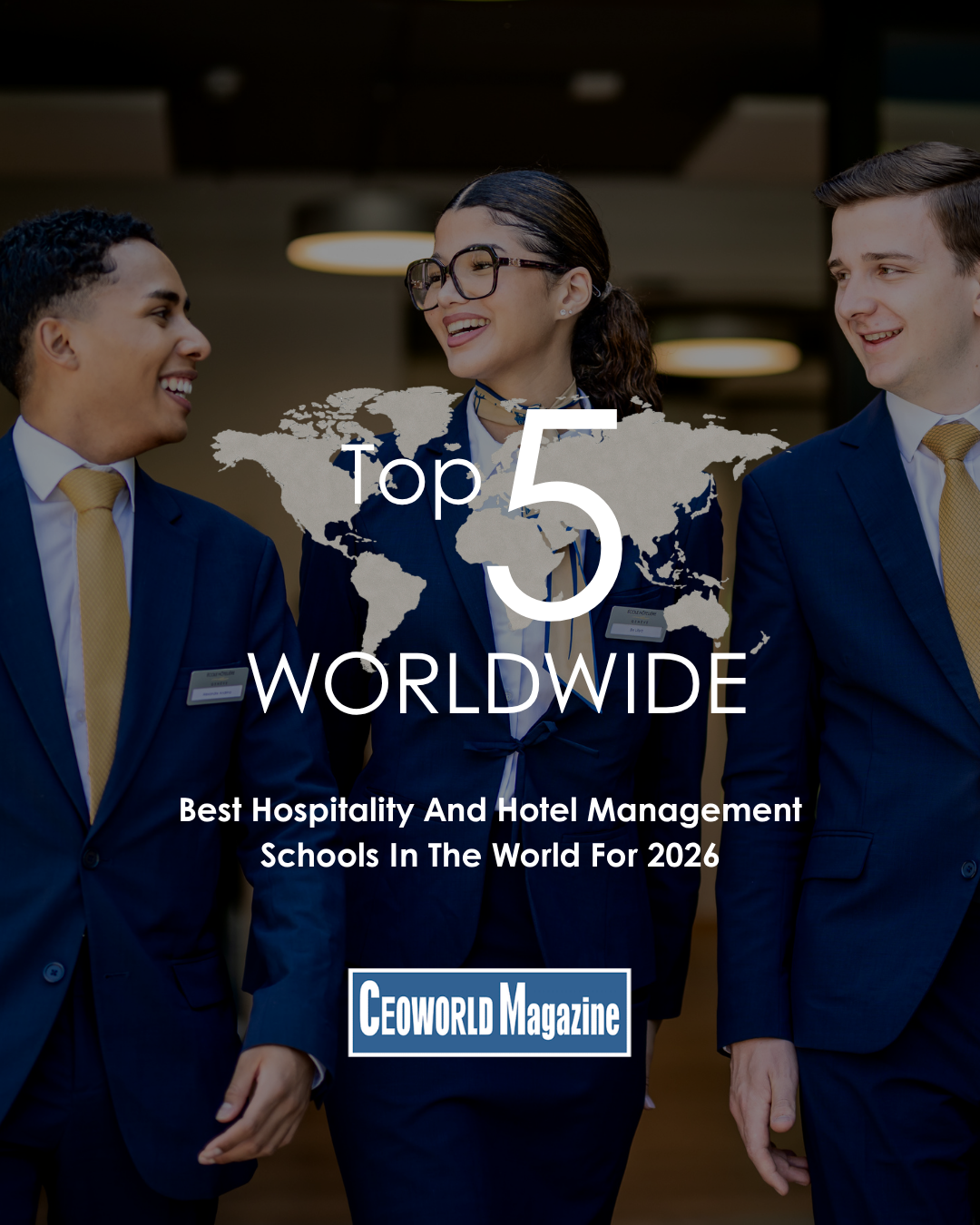
Ranked as the 5th best hotel management school in the world, the École Hôtelière de Genève stands out for its accreditations and awards, which reflect the rigor of its teaching and the effectiveness of its methods.
These labels of excellence, awarded by leading academic and professional bodies, confirm our position as a benchmark in hotel training. They are the fruit of the daily commitment of our community and of an educational vision that combines tradition and innovation for the benefit of our students.
One campus, three paths to success
Diplomas, specializations and certificates: a range of courses to suit every ambition.


Higher education
The ES Diploma in Hospitality and Restaurant Management offered by the École Hôtelière de Genève is a federally recognised tertiary level professional qualification. It is classified at level 6 of the Swiss National Qualifications Framework for Vocational and Professional Qualifications, providing a clear indication of its standing within the Swiss education system.
Post-graduate courses
Participants earn a recognized Swiss federal diploma (accreditation pending), enabling them to specialize in one of three strategic areas of expertise: Creative Event Conception & Organization, Hotel Management or Luxury Hospitality & Product Management.
Specialized Certificates
The certificates issued by the École Hôtelière de Genève offer an exclusive
opportunity to rapidly enhance your skills, within an academic framework of excellence recognized in Switzerland and internationally.

Affiliated with AGEP and CRODES, the École Hôtelière de Genève strengthens its academic credentials.
The École Hôtelière de Genève is a member of the Association Genevoise des Écoles Privées (AGEP) and the Conférence Romande des Écoles Supérieures (CRODES).
These affiliations testify to our commitment to high standards of quality, professionalism and outreach in the field of hotel training.

THE-ICE x EHG
Worldwide recognition for École Hôtelière de Genève's commitment to quality
The École Hôtelière de Genève (EHG) is a VErified establishment by THE-ICE (International Centre of Excellence in Tourism and Hospitality Education), recognizing its commitment to excellence in professional hospitality education and its alignment with recognized international standards.
THE-ICE is a global network of institutions and organizations committed to the development of quality and innovation in tourism and hospitality education. This recognition testifies to EHG’s commitment to continuous improvement, international benchmarking and participation in a global community of major players in hospitality education.
Erasmus+ mobility
The École Hôtelière de Genève (EHG) plans to actively participate in Erasmus+ mobility projects for students and staff.

Participation in the Erasmus+ program
The École Hôtelière de Genève (EHG) sees the Erasmus+ program as an essential lever for strengthening the international outlook of its courses and developing the intercultural skills of its students and staff. Our participation in the Erasmus+ program is structured around the following actions:
Key action 1
Incoming student mobility
We will welcome incoming students to our Graduate School program for a 12-month learning experience starting in 2028 (6 months of theoretical courses on campus and 6 months of internship in Switzerland). Incoming students will be able to enter the second year if they have already successfully completed a first year equivalent to the first year of the EHG program, taught in French. Once their level has been checked and validated by the academic team, they will receive all the information they need to register.
Outgoing student mobility
Outgoing student mobility concerns international internships, directly linked to the learning objectives of our programs, the acquisition of language skills and the discovery and practice of life and work in a different cultural context. These internships are organized within the framework of formal tripartite agreements with partner hotels and restaurants, guaranteeing a clear definition of pedagogical objectives, working conditions, supervision and academic follow-up.
Internships are an integral part of our programs. International mobility projects are implemented by the internship office, in close coordination with the academic department. Students complete three internships in the course of their studies, usually in March or September. Internships can take place in or outside Europe, and in most cases last six months. Students apply for the internships of their choice via the “EHG Talents” platform, after which a contract is drawn up. In 2025, 38% of students eligible for an international internship completed at least one placement abroad, a significant proportion of which was supported by Movetia.
Staff mobility
We also welcome incoming teachers to our Graduate School program, so that they can teach courses in their area of expertise or observe EHG’s teaching practices. As courses are taught in French, a B2 level is required to fully benefit from the experience. Staff mobility can be organized by the academic department in accordance with current regulations.
Outgoing staff mobility
Staff mobility for training purposes is designed to support pedagogical development, the learning of best practices, the transfer of innovations and the strengthening of international academic and professional networks. All staff mobility initiatives are coordinated by the academic department, to ensure transparency, preparation, follow-up and evaluation of mobility.
The first project concerns English language training for teaching staff in Malta, organized over two weeks in April and May, followed by three weeks in October and November 2026. Participation in Erasmus+ is an integral part of EHG’s overall internationalization strategy, contributing to both institutional development and student employability.
In order to evaluate these mobility projects, and with a view to continuous improvement, compulsory surveys of students and staff will be carried out. The results of these surveys will be monitored and reported on regularly.
Key action 2
Cooperation between organizations and institutions
As a vocational training institution, EHG attaches great importance to close links with the professional world. It has developed a range of B2B projects with local and international partners. These include real-life in-company projects, consultancy assignments, tailor-made training courses, as well as initiatives to innovate and observe industry best practice.
Strategy, objectives and impact
The EHG's international strategy is structured around three priorities
– Student development
– Stakeholder engagement
– Staff professional growth
Participation in Erasmus+ supports the following objectives
– Increase international exposure to global dynamics for our students and staff
– Improve access to high-quality international internships
– Strengthen cooperation with foreign institutions and industry partners
– Develop intercultural and professional skills
– Modernize teaching practices
– Strengthen innovation through international inspiration and best practices
– Expand institutional networks
The expected institutional impact includes improved employability, enhanced academic quality, greater international visibility, more innovation and enhanced organizational capacity for cooperation. Participation in Erasmus+ contributes to building a European learning culture by promoting recognition, inclusion and professional mobility.
Indicators
Results are tracked using quantitative and qualitative indicators
Quantitative indicators
Incoming students
As a new type of mobility at our school, we plan to implement it from 2028, with a target of one student in that year. For the years 2029 and 2030, the target will be one student per semester.
Outgoing students
We are seeing an annual increase in international internships among our students (13 mobilities in 2024, 28 mobilities in 2025). Our target for 2026 is to reach 40% of students in semesters 4 and 6, i.e. 48 students. For 2027 and 2028, we aim to reach 50% of students in semesters 4 and 6, i.e. 60 students.
Incoming personnel
The target for 2026 is 0 mobility. For 2027 and 2028, the target is 2 mobility.
Outgoing personnel
The target for 2026 is 12 mobilities. For the years 2027 and 2028, it amounts to 16 mobilities.
Qualitative indicators
Incoming students
Qualitative indicators will be defined and explained once the project is fully up and running.
Outgoing students
– Percentage of students attending information session on international internships: 64% for winter 2025, 46% for spring 2026
– Percentage of students having completed the international internship preparation file: 33% for winter 2025, 25% for spring 2026
– Percentage of students satisfied with their integration into their international placement
– Percentage of students having completed an international internship: 38% for winter 2025, 28% for spring 2026
– Percentage of students asking for help during their internship
– Percentage of students rating their international internship experience as good or very good in their internship report: 88% by winter 2025
Incoming personnel
– Satisfaction interview at the end of the mobility
Outgoing personnel
– Number of staff members having the opportunity to participate in an international exchange: 10 in 2026
– Collection of feedback after staff mobility
These indicators enable EHG to assess short-, medium- and long-term impacts and adjust implementation accordingly.
Key action 2 (KA2) - Cooperation between organizations and institutions
As a vocational training institution, EHG attaches great importance to close links with the professional world. It has developed a range of B2B projects with local and international partners. These include real-life in-company projects, consultancy assignments, tailor-made training courses, as well as initiatives to innovate and observe industry best practice.


